The Gucci Story
 |
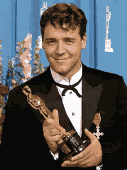 Did You Know there's Gucci movie to star Russell Crowe as Maurizio Gucci, directed by Ridley Scott?
Born in 1881, craftsman’s son Guccio Gucci founded the House of Gucci as a saddlery shop in Florence in 1906. Guccio's first talent was his craftsmanship in leather goods. He started out selling leather bags to horsemen in the 1920’s and progressed to luxury luggage as his clients graduated from equine transportation to horseless carriages. In 1938 Guccio Gucci opened his first retail shop on the Via Condotti in Rome.
 Guccio Gucci, dishwasher to travel bag merchant
The company's history really began in 1921 with patriarch Guccio Gucci, a Florentine dishwasher turned leather merchant, who began selling leather travel bags. Surviving both the Depression and World War II, the family business prospered on its use of a distinctively flawed leather called "cuoio grasso," the ruffled surface of which, superimposed with the twin Gs of the family name, became a global sensation in the years after the war.
 Aldo builds the company despite family feuds
Unfortunately, a family schism began with Guccio's sons. Aldo, the sharp-minded businessman, expanded Gucci's business into new markets, shrewdly identifying its merchandise with distinct markings like red-and-green webbing. He relentlessly pushed for expansion, opening stores in Paris, New York, even Tokyo. By 1974, author Sara Gay Forden wrote in her book, The House of Gucci, "The Gucci empire ... numbered fourteen stores and forty-six franchised boutiques around the world. In just twenty years Aldo had built Gucci from a $6,000 corporation and a small shop in the Savoy Plaza Hotel into a glittering empire spanning the United States, Europe, and Asia."
 But Aldo wasn't completely above board. He also wound up in a $7 million tax fraud scandal, which ultimately enabled his nephew Maurizio to take control over the company board of directors. Maurizio, son of Aldo's brother Rodolfo, had already crossed swords with his father over his marriage to Patrizia Reggiani, a truck driver's daughter whom the elder Guccis saw as a gold-digger marrying her way to wealth. A fiery feud followed Rodolfo's death, after which Maurizio produced documents signing Rodolfo's shares over to Maurizio, which both saved him from massive inheritance taxes and made him a primary shareholder.
That brought him squarely into conflict with Aldo. The legal battles that followed culminated with Aldo's son Paolo squaring off with Maurizio, Aldo having been sent to prison in 1986 at the age of 81. The family was disintegrating; boardroom meetings were punctuated by flying ashtrays and screamed obscenities.
 While the family fights the company grows
But there was a silver lining even in acrimony. "Ironically, the fighting helped fuel the notoriety of the name," Forden said. "It was a rare case where negative publicity wasn't necessarily a bad thing. At one point I interviewed Luigi Pirovano, who was Rodolfo Gucci's driver, and later Maurizio's. He said the family would fight and fight, and people would pour into the stores and the sales would grow, and it was as though there was a connection between the two." Meanwhile, celebrities, led by Jackie Kennedy, embraced the brand.
Money, blood takes its toll
Fighting between the relatives (and across generational lines) took its toll. By 1989, nearly 50 percent of the business had been bought out by Investcorp, a group of investment bankers angling for shares of the business. Maurizio was ostensibly in charge, but Investcorp was in the driver's seat. Maurizio put together a top-notch team: Gucci America CEO Domenico de Sole, creative director Dawn Mello, and head designer Tom Ford. It was an attempt by Maurizio to realize his forward-looking vision of Gucci as a modern corporate fashion entity.
Fighting between the relatives (and across generational lines) took its toll. By 1989, nearly 50 percent of the business had been bought out by Investcorp, a group of investment bankers angling for shares of the business. Maurizio was ostensibly in charge, but Investcorp was in the driver's seat. Maurizio put together a top-notch team: Gucci America CEO Domenico de Sole, creative director Dawn Mello, and head designer Tom Ford. It was an attempt by Maurizio to realize his forward-looking vision of Gucci as a modern corporate fashion entity.
And, like many visionaries, he failed.
Embroiling himself in a spectacular divorce from Patrizia, Maurizio proceeded to run up unprecedented debts. He was considered a visionary leader but a poor manager by colleagues, which, coinciding with plummeting sales in the early '90s, caused Maurizio to be edged out of the company by Investcorp.
 Tom Ford rises to the top
De Sole and Ford advanced to the top tier of Gucci under Investcorp's leadership, with Mello returning to Bergdorf Goodman. Ford began churning out racy, groundbreaking new designs, like stiletto pumps and G-strings, which would never have seen the light of day under the Guccis. They were exceedingly popular, and the Gucci name became more valuable than ever.
Current Gucci LeadershipFormer CEO Domenico de Sole and creative director Tom Ford, who restored Gucci's glitz after near bankruptcy in the 1990s, departed when majority shareholder Pinault-Printemps-Redoute sought to limit their autonomy. Current Gucci CEO Mark Lee is bullish about 2006. In an interview with Women's Wear Daily, he said that the company “had the best year in the history of the company, so we are quite proud and happy about that”. Gucci, founded in 1921 by a former dishwasher, now includes such well-known design labels as Yves St Laurent, Bottega Veneta, Sergio Rossi, Boucheron, Bedat & Co., Balenciaga, Stella McCartney and Alexander McQueen.


No comments:
Post a Comment